

TINY HOUSE

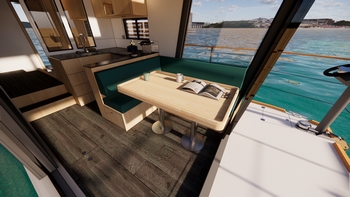
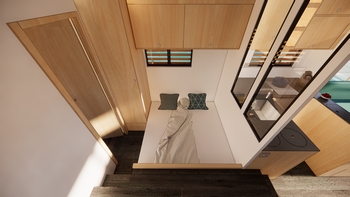
A tiny house is a small house on wheels. In English, “tiny” means minuscule, and “house” means house. The “Tiny House Movement” emerged in the USA in the early 2000s, advocating a simpler lifestyle and voluntary frugality. Habitable year-round, our Tiny Houses are designed like traditional timber-frame houses and built to the same high standards of comfort: insulation, airtightness, electricity, hot water, heating, and mechanical ventilation, with the added benefit of ethical practices! The challenge lies in optimizing space. Inside a Tiny House, saving space is essential. Sliding closets, multifunctional spaces, hatches, fold-down shelves, modular or hybrid furniture: we employ a wealth of ingenuity to improve your well-being and the ergonomics of your living space.
Living differently
A Tiny House has minimal environmental impact, largely due to its small footprint. Its low running costs also significantly reduce housing expenses: no need for building land or permits, low property taxes, and minimal maintenance fees. Living in a Tiny House requires letting go of the unnecessary to focus on what truly matters. You rediscover time for yourself and others, and you learn to appreciate life's simple pleasures.
La mobilité de cette micro maison en fait la solution idéale pour vivre au gré de vos envies. Elle permet de s’adapter aux divers changements et opportunités qui se présentent au cours de la vie. Mais une Tiny peut être nomade… ou pas. Accolée à une terrasse en bois ou augmentée d’un jardin d’hiver, elle peut rester de longues années au même endroit.
Tous les enfants rêvent de vivre dans une cabane. La Tiny House permet de réaliser ce rêve avec tout le confort d’une vraie maison.
The ALUR law : French law and regulations relating to lightweight housing
In France and across Europe, tiny houses have become increasingly popular. This type of housing is environmentally friendly, energy-efficient, and ecological. But most importantly, it is now permitted as a primary residence.
Indeed, the ALUR law (Access to Housing and Renovated Urban Planning – ALUR Law: everything you need to know in 4 points (legalplace.fr)), also known as the Duflot II law, has facilitated access to housing in France since 2015, particularly with regard to the development of new forms of housing. It aims to take into account all alternative housing models and to treat lightweight and mobile dwellings as permanent residences.
It should be noted that certain conditions must be met in order to qualify for the title of a mobile or demountable dwelling.
- The dwelling must be demountable, and no component, whether internal or external, should be permanently fixed.
Its installation and dismantling must be possible and carried out without the use of heavy machinery.
Connections to public utilities—water, electricity, and sewage—must not burden the local authorities' budget.
The dwelling's occupants are responsible for maintaining the cleanliness, hygiene, and upkeep of the premises to prevent fires.
Parking and building permits for Tiny Houses
Regarding parking regulations, your Tiny House can remain on private land as well as agricultural land. However, certain rules must be followed :
- Toute installation dont la durée dépasserait 3 mois par an, et dont l’emprise au sol ne dépasse pas 20m², hors mezzanine, fait objet d’une déclaration préalable de travaux en mairie (Code de l’Urbanisme). Vous pouvez télécharger le formulaire CERFA13404 sur ce lien.
- Si la superficie de votre Tiny House dépasse 20m² d’emprise au sol, vous aurez besoin d’une demande d’un permis de construire.
Areas where parking is prohibited :
- Strictly defined agricultural zones (A) and protected natural areas within Local Urban Development Plans (PLU);
In areas where isolated camping and the creation of campsites are prohibited;
Woods, forests, and parks classified by a PLU or POS as wooded areas to be preserved. This also applies to forests classified under Title I of Book IV of the Forestry Code.
However, you can park your Tiny House in designated non-building zones, known as "pastilles." The Local Urban Development Plans (PLU) of each municipality define these specific zones. Before embarking on your Tiny House project, we advise you to consult your municipality's PLU.
Moving a Tiny House in France
When traveling, Tiny Houses are considered caravans. This applies if their dimensions do not exceed a width of 2.55 m, a height of 4.50 m, and a weight of 3.5 tonnes. Beyond these limits, it is considered an oversized load.
Different driving licenses are required depending on the GVWR (Gross Vehicle Weight Rating), which is the combined weight of the tiny house and the towing vehicle.
A GVWR of vehicle + trailer less than or equal to 3500 kg: Category B license
A GVWR of vehicle + trailer greater than 3500 kg and less than 4250 kg: Category B license and B96 training
For a GVWR of vehicle + trailer greater than 4250 kg: Category BE license
Our Tiny House models require a Category BE license.
How to insure your Tiny House ?
A Tiny House is both a dwelling and a trailer. This requires you to take out two types of insurance policies.
Your Tiny House trailer must be registered and insured before it can be driven on public roads.
When parked, it must be insured with a comprehensive home insurance policy or a mobile home insurance policy.
Tiny Houses and Taxes in France
A house on wheels has a special tax status. Therefore, you will not have to pay property tax or council tax (except for the land itself, if you own it).
A development tax also applies when you submit your building permit application or your prior declaration of works. The municipality sets the amount. For more information on this tax, visit the government website